

The 2 a.m. power failure alarm on a CPAP machine is a specific kind of terror. In a hospital, it’s an inconvenience. In a tent 40 miles from cell service, it’s the reason you’re wide awake, doing mental math about how many hours until sunrise. If you rely on positive airway pressure therapy, camping isn’t just about comfort anymore, it’s about logistics. Finding the best solar generator for CPAP use isn’t a luxury purchase. It’s medical infrastructure you’re taking into the woods.

- Powerful yet Compact: Boasting a 1,500W AC output and a 3,000W surge peak, the Solar Generator 1000 V2 can power multiple appliances, including...
- One Hour Fast Charging: Charge your Explorer 1000 v2 Portable Power Station from 0% to 100% battery level in just one hour with emergency...

Key Features & Performance
Let’s talk about the number that actually matters when you’re camping with CPAP: watt-hours, not watts. Watts tell you how fast a device draws power. Watt-hours tell you how long it can run before it dies. This unit ships with a battery capacity in the 1,000Wh range, which sounds abstract until you run the actual math against your machine.
A standard CPAP without a heated humidifier pulls roughly 30-60 watts on average, depending on your prescribed pressure setting. Higher pressure settings (think 15-20 cmH2O) push more air, which means the motor works harder and draws more current. If you run a heated humidifier and heated tubing, that number can spike to 80-100 watts, sometimes higher during cold nights when the heater is compensating for ambient temperature. That single variable, heat, is the biggest battery killer in this hobby.
On paper, a 1,000Wh battery running a 40-watt CPAP setup should deliver around 20+ hours of runtime. In practice, expect closer to 14-16 hours once you factor in inverter conversion loss, which typically eats 10-15% of your stored capacity. That’s still two full nights on a single charge for most low-pressure users without humidification.
This is a pure sine wave power station, not a modified sine wave unit, and that distinction is not marketing fluff. Most modern CPAP machines are designed to run on pure sine wave output. Modified sine wave power can cause the machine’s internal transformer to run hotter, buzz audibly, or in rare cases, trigger error codes. If you’ve read horror stories online about a CPAP “not recognizing” a power source, this is usually why.
Recharging works three ways: wall outlet (fastest, roughly 2 hours to full), car outlet, or solar panels. The included MPPT solar charge controller handles fluctuating panel input efficiently, which matters on partly cloudy days when output isn’t consistent. Build quality feels solid, rubberized corners, a recessed carry handle, and a display panel that’s readable in direct sunlight, though the screen brightness could be better for reading it at 2 a.m. without fully waking up.
Pros & Cons
- Pure sine wave output confirmed compatible with ResMed and Philips Respironics CPAP units
- Silent operation, zero fan noise at low draw, which matters when you’re sleeping six inches from it
- MPPT solar controller charges efficiently even with partial cloud cover
- LiFePO4 battery chemistry rated for significantly more charge cycles than older lithium-ion units
- Multiple output ports let you run a CPAP and charge a phone or headlamp simultaneously
- Display screen dims aggressively after 10 seconds, annoying if you’re checking stats in the dark
- At roughly 22 lbs, it’s not “backpacking light,” this is a car camping or overlanding tool
- Solar panels sold separately on most bundles, factor that into your real budget
- Fan does kick in under heavier loads (like running humidifier + heated tube), audible but not disruptive
A Great Alternative
If your budget is tighter, or you’re specifically looking for something built around faster recharge speeds rather than maximum capacity, this alternative is worth a look. It trades some total watt-hours for a smaller footprint and quicker wall-charging times, which suits weekend campers who have consistent access to power between trips rather than true off-grid stretches.
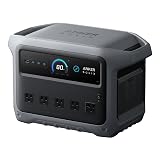
- 49 Min UltraFast Recharging: With upgraded HyperFlash tech, fully recharge at 1,600W—for outage prepping, camping trips, or tailgating events...
- 2,000W Output via 10 Ports: Delivers 2,000W (3,000W peak) and 1,024Wh capacity. Power up to 10 devices—ideal for emergency backup, remote work...

Final Verdict
Rather than hand you a star rating and call it done, here’s what actually matters more: a troubleshooting plan. Because gear fails, and when it’s tied to your breathing at night, you need a plan B before you need it.
What if the inverter fails mid-trip?
Every pure sine wave inverter has a failure point, usually from overheating or a surge event. If yours cuts out, don’t panic and don’t keep pressing the power button repeatedly, that can damage the circuit further. Disconnect the CPAP, let the unit cool for 15 minutes, and try a restart. If it won’t reset, switch to your backup power source immediately (see below).
Do you need a backup power source?
Yes. Non-negotiable. A secondary option, even a basic 12V CPAP battery adapter that runs off a car battery, is cheap insurance. The American Sleep Apnea Association notes that even short interruptions in therapy can affect sleep quality for people with moderate to severe OSA, so treat backup power as part of your medical kit, not an accessory.
What if the battery won’t hold a charge in cold weather?
Lithium battery performance drops in temperatures below 32°F. Store the unit inside your tent or vehicle overnight, never in an exterior storage bin. According to the U.S. Department of Energy, lithium-based batteries can lose significant capacity in freezing conditions, which directly impacts how many hours you’ll actually get from a full charge.
What if the solar panels aren’t generating enough input?
Cloudy days happen. Prioritize charging via car outlet during any drive to your campsite as a supplement, and always start a multi-day trip with a full battery from a wall charge, don’t rely on solar as your primary source for critical medical equipment.
Ultimo aggiornamento 2026-10-28 / Link di affiliazione / Immagini da Amazon Product Advertising API