
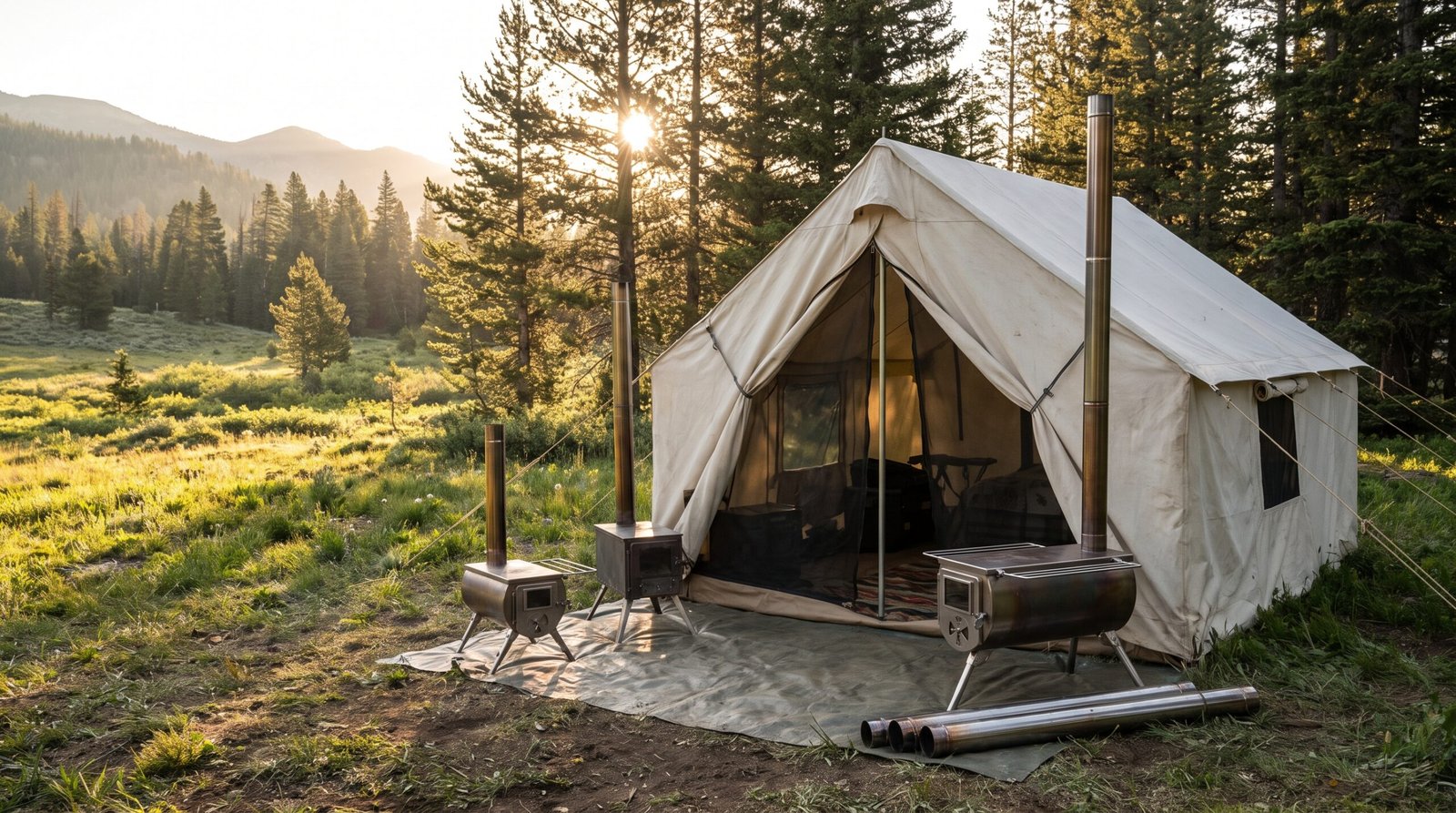
Walk into any hot tenting forum and you’ll see the same question posted a hundred different ways: “What size stove do I need?” The answer everyone wants is a simple chart. The answer that actually works requires you to think like an engineer for about ten minutes. Stick with me here, because getting this wrong means either freezing at 2 AM or sweating through your sleeping bag while your stove glows cherry red.
This tent stove sizing guide is going to break down BTUs the way I’d explain them to a buddy over a beer, not the way a textbook would. No fluff, no generic “it depends” cop-outs. By the end, you’ll have a worksheet you can actually use to size your setup correctly, whether you’re heating a 4-person bell tent or a canvas wall tent the size of a small cabin.
What a BTU Actually Is (The Bar Napkin Explanation)
BTU stands for British Thermal Unit. Officially, it’s the energy needed to raise one pound of water by one degree Fahrenheit. Forget that definition the second you’ve read it, because it’s useless for camping.
Here’s the version that matters: think of BTUs as the “horsepower” of your stove. A tiny titanium backpacking stove might put out 8,000-10,000 BTU/hr, enough to boil water fast but not enough to heat a room. A residential furnace puts out 60,000-100,000 BTU/hr, because it’s fighting against an entire house’s worth of heat loss. Your canvas tent stove sits somewhere in between, and where exactly depends on math we’re about to do together.
The key insight most guides skip: BTUs aren’t about “how hot” a stove gets. They’re about how much heat energy it can pump out per hour to replace what’s escaping through your tent walls. Canvas is not insulation. It’s a windbreak with pretensions. Every square foot of that fabric is bleeding heat to the outside air, and your stove’s entire job is to replace that loss faster than it happens.
Tent Stove Sizing Guide: The Core Formula
Here’s the actual engineering approach, simplified for canvas tents. You need to calculate heat loss, not just “tent size.” A 6-person bell tent in Georgia and the same tent in Montana need wildly different stoves, even though the floor space is identical.
The formula construction crews and off-grid cabin builders use looks like this:
BTU needed = Tent Volume (cubic feet) × Temperature Differential × Insulation Factor
That sounds intimidating. It isn’t. Let’s build your worksheet.
Step 1: Calculate Your Tent’s Volume
Don’t use floor space, that’s the rookie mistake. A tall bell tent with a steep pitch has way more air volume to heat than a low-profile wall tent with the same footprint. Measure length × width × average height. For a bell tent, average height is roughly 60% of your peak height because of the conical shape.
- Example: A 13-foot bell tent (roughly 132 sq ft floor) with a 9-foot peak has an average height around 5.4 feet, giving you roughly 713 cubic feet.
Step 2: Set Your Temperature Differential
This is the gap between outside temp and your target inside temp. If you’re camping where it drops to 20°F overnight and you want 65°F inside, your differential is 45 degrees. This single number is why people in Texas and people in Minnesota cannot use the same stove recommendation, ever.
Step 3: Apply the Insulation Factor
Single-layer cotton canvas: multiply by 1.0 (baseline, leaky).
Canvas with a liner or double-wall construction: multiply by 0.7 (noticeably better).
Canvas tent pitched with a good ground tarp and snow skirt sealing drafts: knock another 10% off.
Run the math on our example bell tent: 713 cubic feet × 45°F differential × a rough constant of 0.133 (this constant accounts for canvas’s poor R-value, derived from field testing by hot tent manufacturers) gets you to roughly 4,200 BTU/hr minimum, before insulation adjustments. Round up, add a 20% safety margin for wind and cold snaps, and you’re looking at a stove rated 5,000-6,000 BTU/hr for that specific scenario.
BTU for Bell Tent: Real-World Numbers by Size
Since everyone wants the shortcut anyway, here’s the cheat sheet based on moderate winter conditions (20-30°F nights) with a decent double-wall canvas. These numbers assume you’re not trying to heat a tent to tropical temperatures, just a comfortable 60-65°F.
- 4m / 13ft bell tent (solo or duo use): 4,000-6,500 BTU/hr
- 5m / 16ft bell tent: 6,500-9,000 BTU/hr
- 6m / 20ft bell tent or small wall tent: 9,000-13,000 BTU/hr
- 8-person+ canvas wall tent: 13,000-18,000 BTU/hr
Notice something important: bigger isn’t always better. A stove rated too high for your space will force you into constant damper adjustments, and you’ll either cook yourself out or burn fuel inefficiently. This is the single most common mistake in winter camping wood stove setups. People buy the biggest stove they can find, thinking “more heat = more safety margin,” and end up fighting their own equipment all night.
If you want a stove that nails this mid-range sweet spot for 4-6 person bell tents, something like this compact option hits the numbers well:

- Cotton Canvas
- Imported

Hot Tenting Safety: Where BTU Math Meets Real Danger
This is the section nobody wants to read and everybody needs to. Oversizing or undersizing your stove isn’t just a comfort issue, it’s a safety issue, and I don’t say that lightly.
An undersized stove running flat-out 24/7 to compensate for being too small will often get over-fired, pushed past its design temperature. That stresses seams, warps steel, and dramatically increases creosote buildup in your flue pipe, which is the leading cause of chimney fires in hot tenting. Creosote isn’t just a wood stove problem, it’s a physics problem: cooler flue temps from an overworked, undersized stove mean incomplete combustion and more tar-like residue coating your pipe.
An oversized stove creates a different danger. You’ll be tempted to damper it down hard to control the heat, which again drops flue gas temperature and invites creosote. Plus, a massive stove in a small canvas space means your clearances to combustible fabric shrink, and spark arrestor screens become non-negotiable.
The National Fire Protection Association publishes clearance guidelines for wood-burning appliances that, while designed for residential stoves, give you a solid baseline for minimum safe distances from canvas, even temporary canvas. Don’t treat your tent stove as exempt from fire science just because it packs down into a bag.
Carbon monoxide is the other silent risk. Always crack a vent, even in brutal cold, and consider a battery-powered CO detector rated for cold temperatures (most consumer units fail below freezing, so check specs carefully).
Draft Control: The Skill That Actually Determines Comfort
Here’s something the BTU chart will never tell you: proper sizing only gets you 70% of the way to a comfortable night. The other 30% is draft control, and it’s a skill, not a spec sheet.
Draft is the airflow pulling oxygen into your firebox and pushing exhaust up your flue. Too much draft and your fire roars through fuel like it’s starving, overheating the tent in spikes and burning through your wood pile by 1 AM. Too little draft and you get smoldering, smoke backing up into the tent, and that awful acrid smell on everything you own.
Think of draft control like the throttle on a car. The stove’s BTU rating tells you the engine size, but the damper is your foot on the gas pedal. A well-chosen stove with poor draft management will perform worse than a slightly undersized stove run by someone who knows how to work the damper.
Practical Draft Control Checklist
- Close the damper gradually, not all at once. Choke it down in small increments after your fire is established, watching how the flame responds.
- Use flue pipe thermometers. Magnetic stovepipe thermometers show you the “danger zone,” “creosote zone,” and “efficient burn zone” visually, taking guesswork out of it entirely.
- Match wood moisture to your draft needs. Wet or green wood needs more draft to combust fully, which means more risk of over-firing to compensate. Seasoned wood under 20% moisture content burns cleaner at lower draft settings.
- Adjust for altitude and wind. Higher elevation means thinner air and less oxygen for combustion, often requiring more draft. Windy conditions outside can create unpredictable downdrafts, so a spinning cap or wind-resistant chimney cap pays for itself fast.
For anyone serious about dialing in these variables, a flue thermometer and a reliable stovepipe damper kit are non-negotiable gear, right alongside the stove itself. Pairing good equipment with the sizing math above is what separates a miserable night from genuinely cozy winter camping:

- Roomy 8 People Family Tent: Spacious tunnel design family outdoor tent for 8 people, with a size 20' (14'+6') x 9' x 80"(H), it is enough for...
- Breathable Mesh Windows: Stay cool with 4 oversized mesh windows,2 doors with mesh ceiling! Cross-ventilation keeps condensation at bay while...
Putting Your Tent Stove Sizing Guide Worksheet to Work
Let’s consolidate everything into a worksheet you can actually fill out before you buy anything:
- 1. Measure tent volume (length × width × average height in cubic feet)
- 2. Determine your coldest realistic night (check historical lows for your typical camping region, not just the forecast)
- 3. Set your target indoor comfort temp (60-65°F is realistic and sustainable, don’t aim for 75°F, you’ll exhaust your fuel supply)
- 4. Calculate the differential (target temp minus coldest expected outdoor temp)
- 5. Apply your insulation factor (1.0 for single-layer canvas, 0.7 for lined/double-wall)
- 6. Add a 15-20% safety buffer for wind, altitude, or unexpected cold snaps
This isn’t guesswork dressed up as science, it’s the same logic HVAC professionals use for load calculations, just scaled down for canvas instead of drywall. The U.S. Department of Energy’s heating load fundamentals are built on identical principles: volume, temperature differential, and material performance. Canvas tenting just compresses the timeline and raises the stakes.
Run your numbers through this worksheet before every major trip, especially if you’re switching tent sizes or heading somewhere genuinely cold for the first time. A properly sized stove, run with good draft discipline, turns a canvas tent into one of the most comfortable ways to camp in winter that exists. Undersized or improperly managed, that same tent becomes a smoky, cold, occasionally dangerous box. The math takes ten minutes. Do it.
Ultimo aggiornamento 2026-10-28 / Link di affiliazione / Immagini da Amazon Product Advertising API